
The “Medical Mindset” – a gap in supporting healthcare innovation
This article is born of recent experiences that got me thinking about how effective we are at supporting innovative new healthcare technologies to get in front of patients where they can be of value. How well does the help we give match the help that’s needed? And do we need to try and find another, better, way?
These topics are also on my mind because, without aiming to be hyperbolic, the healthcare space is one of the most difficult ones to innovate within. Journeys are long, regulation is (rightly) high, and buying decisions fragmented and complex. Innovation failure also has a much bigger cost; in patients’ health, well-being and quality of life
It stands to reason that healthcare needs a special approach, but much of the support that we give is borrowed directly from a generalised innovation space – built mostly for getting innovative products into the hands of consumers, rather than health systems.
So here is an attempt to get my thoughts together and start a conversation – what is your experience of support to technology innovation in the healthcare space? Have you experienced the same things I describe here, or do you see them differently? What do you think we should do (if anything) differently?
Where this began
What got me started in thinking more deeply about this topic are a few experiences and trends I’ve seen cropping up for the last few months or years, these include:
The endless pilot trap: The is a relatively new, but increasingly common discussion topic. A recognition that many early startups are connecting with clinicians, and getting their products into pilots, but that these pilots aren’t successfully bridging them into market. Instead, one pilot leads to another, which leads to another, which leads to another, but without getting closer to a buying decision and patient impact
Focus on ideas not realisation: Much of the support in the healthcare space is focused on the earliest stages of innovation – the innovative idea. We often hear statements like “first you innovate, then you refine the prototype, scale, and sell”, but innovation is not complete until the product is in the market delivering value. Successful innovation necessarily includes R&D, approval, scaling, and adoption, and not recognising this fools us into believing we’re supporting innovation when in reality, we’re supporting idea generation alone
Support that isn’t hands-on: Related to the above, we also see many ecosystem actors supporting innovation seeing their role as essentially hands off. Their role is expressed as connecting, facilitating, catalysing or advising, but this ignores the deep level of hard hands-on work that is needed, and which startups need support in, to bring an innovative healthcare technology successfully to market
Over-emphasising the clinical voice: This one is a little trickier to talk about. What is great is that there are increasing connections being made between academia and clinicians, giving academics insight into clinical reality ahead of developing and shaping new technologies. What also seems to be happening now though is a positioning of the clinical voice as the voice, whereas clinicians are only one of many stakeholders needed to get a new healthcare technology to patients, and not always the most important voice driving adoption
Confusion between product and process innovation: In addition, when shaping innovation support programs, there appears to be a conflation between process and product innovation. This links up with the focus on early-stage innovation, and expectations of an innovation process that includes core research, testing in a clinical environment, and then immediate scale-up into clinical practice. While this process is achievable for process innovation, where evidenced new ways of doing things can be quickly and easily rolled out, for product innovation, this process skips the hard work required to bridging between an innovative idea, and a real product in a health system benefiting patients
Of course, I’m not presenting this as a comprehensive list of the challenges we have in developing innovative healthcare technologies, but they are a few keys ones that come together to form the core idea behind this article. If you have more feel free to add them in the comments!
The shape of the challenge
So where does this all lead us? We have here a few identified challenges related to our healthcare innovation journey, but at first glance they look disparate and perhaps a little unrelated. For me these topics get at a core reality of developing a medical device that it feels like we’re missing in the way we talk about, design, and deliver support programs
I also don’t think I’m the only person thinking about this, with a great and relevant article by Erik van Dijk on “Surviving the 2nd Valley of Death for MedTech Scaleups” covering what feels like similar, but not identical ground – so I’d also recommend going to read that article.
In short: there are a huge number of core pillars in the development of any healthcare technology – be it a device, diagnostic, digital tool, combination product, etc. – that all need to be addressed and come together to drive success. The challenges listed above all identify however where we’re not recognising this in our current support landscape.
To help explain the point, I drew the diagram below which outlines, for me, the key pillars to get in place for any healthcare technology. You’ll immediately see there’s a lot! And this is not me scraping the barrel for topics, but a relatively high-level description of the scope of topics to be addressed.
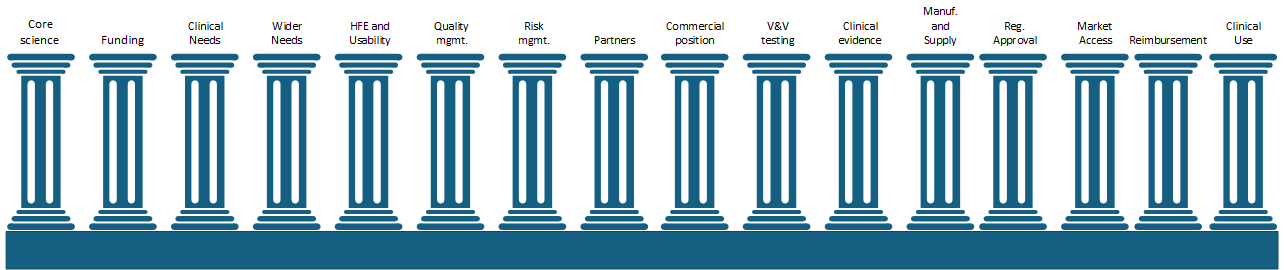
Successful healthcare technology innovation is built on many key pillars
Each of these topics needs lots of hands-on specialist capabilities to deliver. Still further, these topics need to be brought together at the strategic level and be integrated effectively. There is a need, overall, for support in the form of a “Medical Mindset” that understands both the scope of this landscape, and how to address it.
This is where for me the topics listed above come together, in the sense of they come from the absence of provision of this Medical Mindset. Connecting academics into clinicians is great but only addresses the two extreme ends of the journey – the generation of a good idea relative to the need, and generation of a level of confidence that a given innovative idea would have an application in a healthcare setting.
This leaves much unaddressed, including the fact that clinicians, typically, aren’t the people making decisions as to which products are purchased by a health system, how broadly they are disseminated, or the level at which they are reimbursed.
That’s not to be critical of clinicians, or the academic-clinician tie-up. From a Medical Mindset point of view, however, the relationship leaves much unaddressed that still needs to be to launch a successful healthcare technology.
And this is also the source of the “endless pilot trap”. Such pilots are an early way to get a product into a clinical environment, and generate the information that clinicians need to be convinced they are safe, appropriate, and effective. This is though a different question to the more fundamental one: what does a purchaser or health system need to see to introduce this technology systematically? And so, we have endless pilots, because on their own terms each doesn’t fail – it produces evidence of clinical relevance – but they don’t address the wider aspects needed to get from pilot to product.
Similarly support to the initial idea generation side of innovation is value, but it stops short of ensuring that innovation happens. In particular may support the development of a key prototype and concept, but it doesn’t support the alignment of the technical, commercial, and regulatory topics that are key to ticking off all the pillars on the healthcare innovation journey, and producing a product that treats patients, is used by practitioners, reimbursed by health systems, and purchased by individual purchasers. This is even more the case where the support provided is focused on connection, catalysis, and advice, but not provision or development of the hands-on medical mindset which is the true need.
What’s the solution?
Of course, identifying the challenge isn’t enough, the question should always be “so what’s the solution?”. I think they key elements of a solution are four-fold
Connection to all actors, not just clinicians: We should build on the great work focused on connecting academics and startups into clinicians and expand it to include the full range of actors who are critical in driving healthcare innovation adoption. This includes:
Patients as the determiners of their own needs and abilities,
Providers, health systems, to give insight into the wider aspects that for them drive adoption of new technologies (and various writings on Health Technology Assessments can give some guidance here)
Payers to outline what they need in terms of pricing and access and their relevance to adoption
Practitioners, clinicians to outline the clinical needs for the target patient population and indication
Regulators, and their needs in terms of demonstrating safety and efficacy for marketing approval
Explicit recognition of the full journey: We need to stop painting innovation as the generation of an idea, but its realisation on market and delivery of value. This includes explicit recognition and support to all the key pillars that take an idea from the lab to patient hands
Provision of “Medical Mindset” support: Not only providing resources and some individual skills to startups, but providing them directly, or supporting them in developing, this Medical Mindset capability – the understanding of the full healthcare technology journey, and what is needed to successfully get to market. This specifically includes the ability to develop and implement and aligned technical-commercial-regulatory strategy that addresses all the key pillars outlined above
Hands on help: Not stopping at advice or connection, but explicitly providing hands-on help and resources that will be actively supportive to the largest part of the lab to market journey
Overall, I believe that a change in mindset, to recognise the realities of the innovative healthcare technology journey, and how it differs in form and needs from a typical consumer innovation will help us better support startups, reduce preventable product failures, and get much needed technologies in front of patients and improving the health, happiness, and well-being. After all, isn’t this why we are working in healthcare in the first place?
What do you think?
Of course this is just my view, and I’m hugely interested in your thoughts and opinions. Does this tie up with your experience of the medical device, diagnostics, combination product, or digital health space? Is there anything you think I’ve missed or mis-understood? And what do you think we need to do to help startups succeed?
If you’re reading this on our website, please do use the contact form to send me a comment. If you’re reading on LinkedIn, why not drop a comment below?
Lastly, if you’re developing an innovative technology, and need hands-on help or advice in getting from the lab to the clinic, feel free to contact me here for a no-obligation 1:1 chat