
Partnering in healthcare is now essential, but how to make it work?
Hello and welcome back to our series of articles on how to get ahead in developing for, and innovating within, healthcare.
The topic we wanted to explore with you today is partnership; by which we mean the need for two or more organisations to work closely together, not as buyer and supplier, but as a deeply integrated team. We'll cover why you need to do this in healthcare, what partnership is or isn't, and how to build and maintain a strong and successful partnership.
Why Partnership
The need to partner is one of the biggest changes to the development of both medical devices and drug products to emerge over the last few decades. In reality, most drug products and medical devices reaching the market today do so as the result of two or more organisations working together. Of all of the ways to do this - for example buyer-supplier, acquisition, etc - partnership is the most successful.
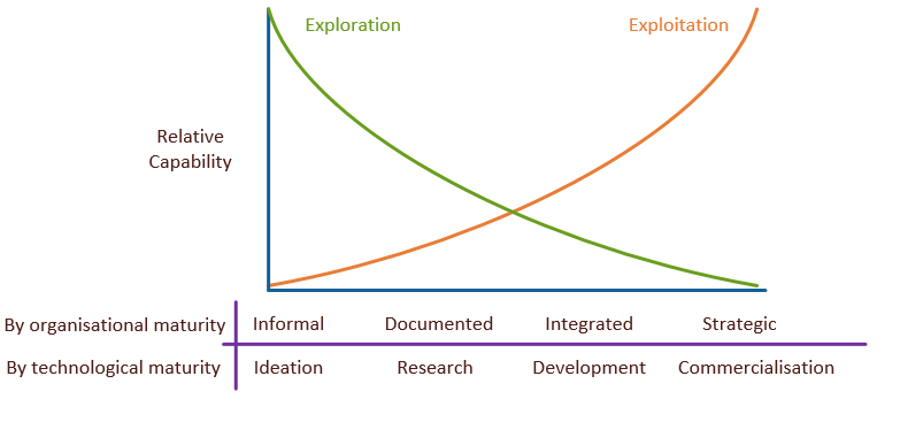
Healthcare innovation move from early exploration to late exploitation. Different organisational types are better at different activities, driving the need for partnership
There are several drivers that make partnership an essential tool for modern healthcare innovation:
Increasing Costs of Development: Taking a drug product, or even a device, from lab to market is costly and long - approximately $1B for a new drug and $10-100M for a device, with costs and timelines increasing. The journey also needs deeply specific and specialist skills in clinical, quality, and regulatory to succeed. Most startups struggle to get access to the needed investment and resources to complete the full journey to market. Startups also typically lack the deep and broad marketing and distribution networks for widespread adoption, and so some form of partnering becomes essential.
Corporates specialise in the late stage: The demands of large pharma and medical device corporates mean they increasingly specialise in late stage development activities such as commercialisation, manufacturing, and marketing. Shortly, the exploitation of innovative ideas for market. The means that early explorative stages of innovation are not only a challenge for which they aren't specialised, but a distraction from their "core" business activities. Yet corporates need a steady innovation stream to populate their development pipelines, making partnering essential tool for their growth.
A relative lack of mid-size companies: Partly due to the above trends, healthcare is dominated by a small number of huge players, and a huge number of very small players, and not much in between - an hourglass market. The tendency away from IPOs as a startup exit strategy, and towards acquisition, creates very few mid-size firms capable of driving full end-to-end innovation - further increasing the need for effective partnering.
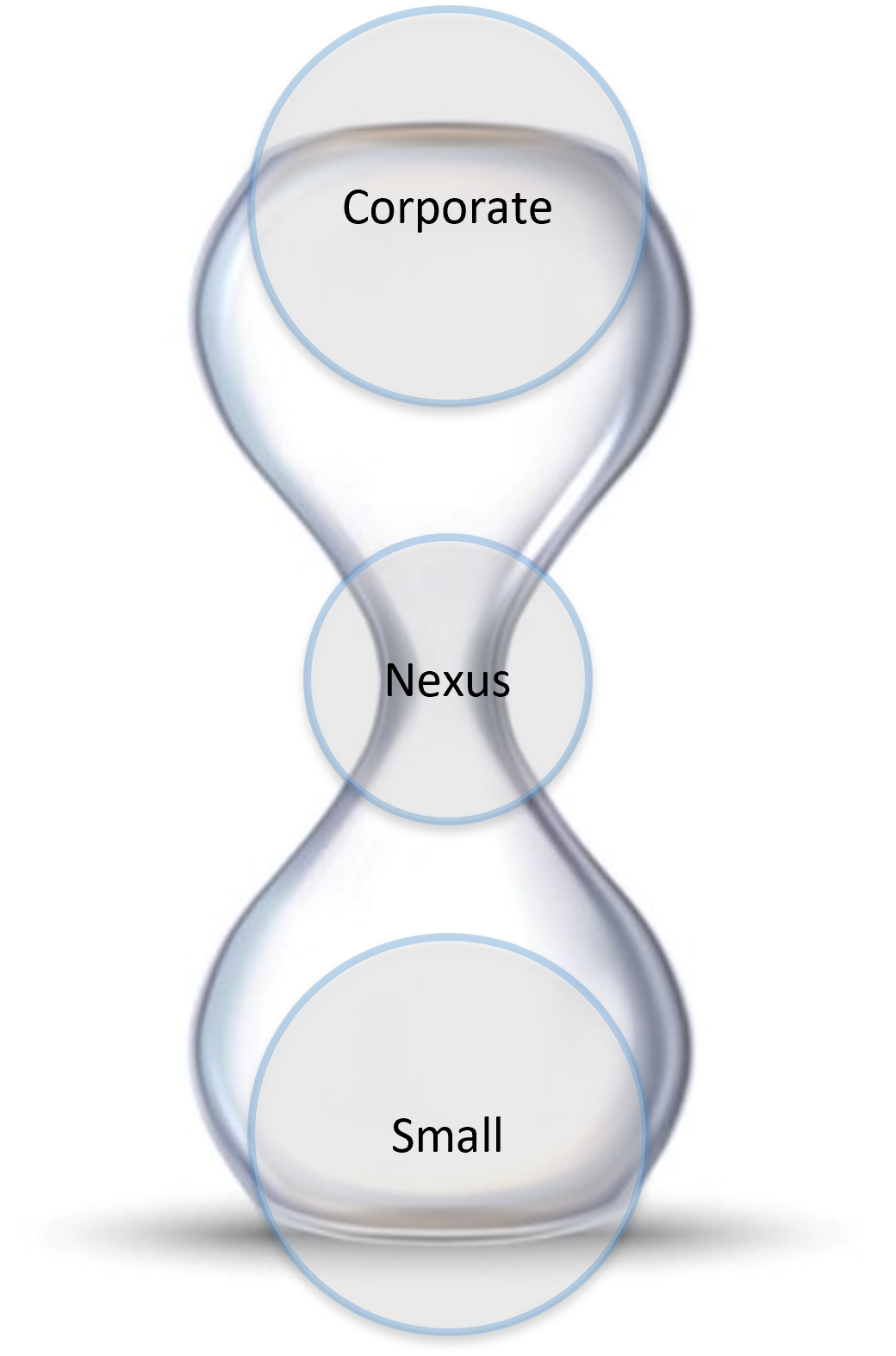
The healthcare development market is an hourglass shape, heavily skewed towards large corporates and small startups
To summarise: It's increasingly rare that a single organisation can cover the full innovation journey in healthcare, and so partnership becomes an essential tactic to bridge the gap from idea to market
What do we mean by Partnership?
Let's take some time now to differentiate partnership from other ways that organisations work together. The two most common approaches are:
Buyer-Supplier: The most common method. One firm outlines a need, and pays a supplier to deliver it. Here the control lies with the buyer; they define the terms of engagement and definition of success. When buying a computer, piece of software or widget, this model works well. It does not work well for innovation however. Bridging successfully from lab to market needs the skills, outlook, and experience of both firms. Supplier relationships often bias the focus towards commercial, manufacturing and marketing concerns, and away from the implementation of innovative ideas. Something may still reach market, but often this is an incremental rather than innovative product.
Acquisition: Increasingly prevalent in healthcare specifically. Here the large organisation simply buys out the smaller organsiation or their product, folding it into their internal development. The challenge is that this is commonly done at a stage where exploration and development is still underway; startups want the early cash and resource injection, corporates want to bring the product swiftly under their own control. This means that the project becomes an exploitation project whether the product itself is ready or not - it being the dominant model for the corporate. This often leads to project failures, as the gap between prototype and product cannot be quickly or easily bridged.
Which opens up the groundwork for partnering. Even where the large organisation ultimately 'owns' the eventual product, the skills, experience and perspective of the startup are still needed, and so need to have some power/influence for the project to succeed. While this influence can drop away as the product successfully transitions into later stages of development, it needs to be a managed transfer.
This balance of skills, experience and outlook can only happen reliably in a partnership model - not one firm purchasing a product or outcome from another, but a joining of both organisations as a single team focused on a common goal. This maintains the innovative project orientation whilst enabling the full journey to market.
A good analogy here is the game theory concept of the prisoner's dilemma. The best outcome for each side is achieved through deep co-operation (even co-creation), but buyer-supplier and acquisition models encourage one-sided action that leads to the worst outcome for both sides. In contrast a true partnership facilitates this co-operative or co-creative operation and an equal balancing of power in the relationship, vastly increasing the chances of an optimal outcome for each organisation.
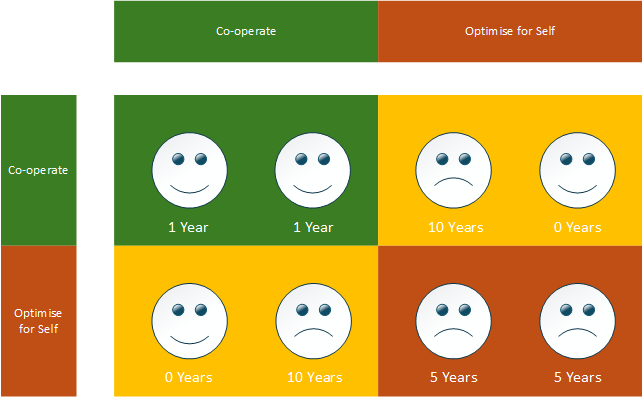
The prisoner's dilemma. The best outcome comes from both participants co-operating. While one partner optimising for themselves may give the best individual outcome, if both partners do this, then they both get a much worse outcome.
A true partnership then involves two organisations being equally empowered, working as a single team, around a common goal that achieves an optimal outcome for both sides.
How to build and effective partnership
Of course building an effective partnership is quite different from understanding what one looks like. One of the largest barriers to effective partnering is inequality of influence between the partners. This is also often exacerbated by cultural differences between the partners - each partner necessarily comes from a slightly different world, and so effort needs to be made to accommodate and integrate both cultures effectively
Our key tips for building and maintaining an effective partnership in healthcare innovation are:
Avoid Dazzle: Most partnerships are made up of partners of mismatched size, and the dynamics of the healthcare industry often mean a very large corporate partnering with a very small startup. This commonly results in the smaller partner feeling "dazzled" by the size, experience, and resources of the larger; de-emphasising their own skills and experience. However, all skills and viewpoints are needed for success, and so specific effort must be made to ensure both partners engage on a level playing field.
Define and align on a commonly understood goal: One consequence of the different sizes, foci and cultures of the partnered organisations is that they may be seeking very different things from the same project. That's not to say that each firm can't obtain benefits specific to them, but the focus of the work must be a well-defined, communicated, understood and agreed goal; a definition of success that delivers to the partners' needs, and superordinately the needs of the project itself. Not doing this undermines effective partnership, greatly lowering the chances of success.
Respect differing organisational cultures and their value: Partnerships by their nature bring together partners with diverse but equally valuable skills, experiences, and viewpoints. While different project phases may lean more on one partner or another, the common understanding must be that both partners bring something of equal value to be shared. This cuts both ways - sometimes the larger partner sees their commercial focus as key, and so strong-arm a partner into their point of view. Alternatively a startup may feel their vision is under threat and seek re-internalise a project to protect it from external scrutiny and influence. Both approaches risk failure, as neither organisation alone has the capability and resources to cover the full innovation journey, and so eventually such a project will fail to overcome a key challenge in the healthcare innovation journey.
Account for different communication styles: Differing cultures across partners mean different communication approaches. Even something as simple as the definition of certain technical terms may very among partners - particularly if the partnering also occurs across disciplines, e.g. corporate pharma with a device startup. Certain organisations may also be more dynamic, or direct, or political, or collaborative, depending on their background. It's crucial to establish a common language and communication approach between partners to facilitate accurate understanding of what each partner says and means, and avoid misunderstandings and conflict.
Map and fit the skills needed at each stage: As a project moves from early stage exploration through to late stage exploitation a wide diversity of skills are needed. The optimal skills balance also evolves with each project stage. Partnerships happen because no single organisation has the complete set of skills and resources required to navigate the full innovation journey. An optimal project applies the right skills mix at each stage. Therefore in a partnership it's important to a) recognise the skills mix needed at each stage, b) recognise which skills each organisation has, and c) apply those skills in the right balance throughout the project. This requires active analysis and management across the project to be effective.
Forge a common co-creative team pulling in the same direction: Optimal project outcomes emerge when organisations don't simply collaborate, but work together in a way that builds on and beyond their individual capabilities. This is co-creation, where 1+1 = 3, due to an integrated and additive way of working between the teams. Facilitated co-creative working is at the heart of the most successful partnerships between organisations, particularly in a multidisciplinary and complex field such as healthcare.

Co-operation vs Co-llaboration vs Co-creation
Summary
Innovation in healthcare needs effective partnering to succeed, with the increasing cost and complexity of getting to market meaning that no single organisation can get there alone. This partnering needs to go beyond buyer-supplier or acquisition models to truly co-creative integrated team working that enhances the capabilities of both partners to deliver to a commonly shared goal.
Doing this effectively requires building a relationship of equals, focused on a common and agreed goal, and that recognises and get the best from the different skills, experiences and outlooks across the organisations involved - creating an effective team all pulling the the same direction to deliver products that deliver for patients, manufacturers and society.
Are you seeking partnership as a large or small organisation in healthcare? Are you seeking help to better understand and implement effective partnership? Please do contact us directly here for a no obligation 1-on-1 chat